Why attic rodent cleanup is a multi-phase process, not a single visit
A Google search for "attic rodent cleanup" returns a lot of results that make it sound simple — HEPA vacuum, spray some disinfectant, done. For a minor roof-rat infestation caught early — a few weeks of activity, limited droppings, no nesting in the insulation — that's roughly accurate. For the more common scenario in Greensboro's canopy neighborhoods, where a roof-rat colony has been active for one or more breeding cycles (3–6 months), it's not.
An established colony leaves contamination that's not addressable with a surface pass. Droppings and urine have penetrated into the insulation body, not just the surface layer. Nesting material is integrated throughout insulation in the corner areas where roof rats concentrate. Wiring in the attic may have gnaw marks. The structural surfaces — joists, rafters, blocking — have urine absorption that requires antimicrobial treatment, not just dusting. And the pathogen load from an established colony includes Hantavirus risk that makes proper PPE and HEPA filtration mandatory — not optional.
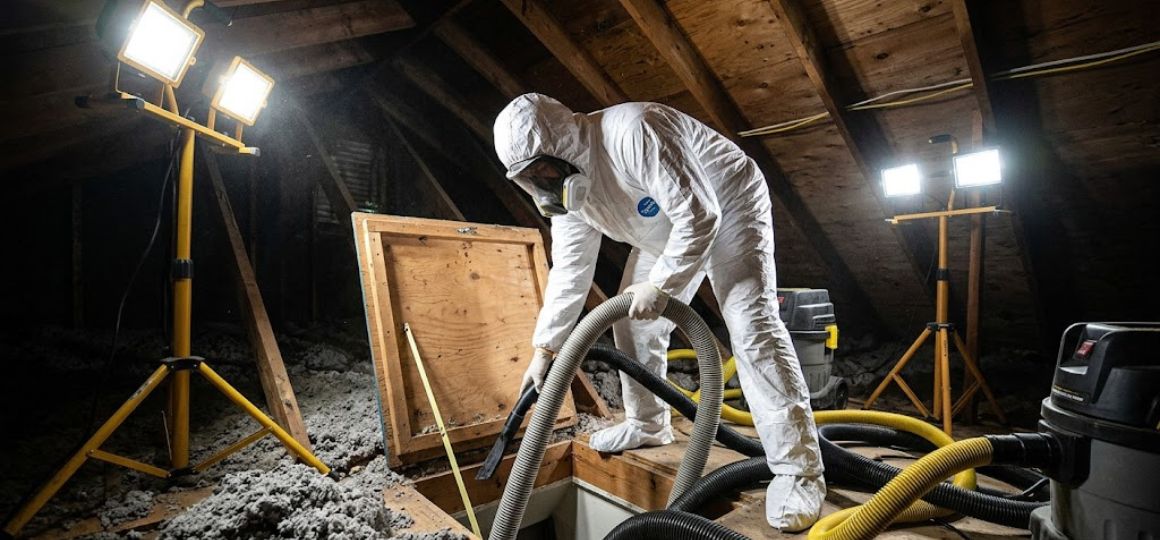
Doing this correctly takes multiple hours on site and leaves the attic clean enough that a new insulation installation doesn't trap contamination beneath it. Doing it incorrectly — surface vacuuming with standard equipment, a spray of household disinfectant, adding new insulation on top of contaminated old insulation — perpetuates the odor and pathogen risk that prompted the cleanup to begin with.
The five cleanup phases — what happens in each
Phase 1: Ventilation. Before entry, open gable vents and the attic access for a minimum of 30 minutes to dilute any aerosolized contaminants from the accumulated droppings. CDC Hantavirus guidelines specify ventilation before human entry into rodent-contaminated spaces. This is not just a precaution — Hantavirus is shed in rodent urine, saliva, and droppings and becomes infectious when the particles are disturbed. Ventilation reduces particle concentration before the technician enters.
Phase 2: Nest and debris extraction. Manual removal of all nesting material — shredded insulation, paper, fabric, and plant debris that roof rats have incorporated into nest structures — in sealed disposal bags. Extraction also includes any dead rodent carcasses. This phase requires identifying every nest site, which in an established colony may be 3–8 sites distributed across the attic floor in the corners and eave-line areas where roof rats concentrate.
Phase 3: HEPA vacuum. Systematic HEPA-filtered vacuum of the full attic floor — all insulation surface areas and all exposed structural surfaces (joists, blocking, rafters). Standard shop-vac or household vacuum is inadequate — the exhaust air returns unfiltered particles to the space. A HEPA vacuum captures particles at the 0.3-micron level that includes Hantavirus-sized particles. The vacuum phase is slow and thorough, not a single pass.
Phase 4: Antimicrobial treatment. Spray application of diluted antimicrobial solution across all vacuumed surfaces. The HEPA vacuum removes the physical material; the antimicrobial addresses the residual pathogen load on structural surfaces. Dwell time per product label, then allowed to dry. For significant infestations, a second application may be warranted.
Phase 5: Enzymatic odor treatment. Application of enzymatic deodorizer at urine-concentration areas — the corner sections, eave-line areas, and insulation zones where the odor is most concentrated. Enzymatic breakdown of urine compounds addresses the odor source rather than masking it. This is the phase that makes the difference between "we treated it but it still smells" and "the odor is gone."
How to assess whether your attic insulation needs replacement
This is the question that determines whether attic cleanup is a $500–$1,200 job or a $2,500–$6,000 job. The assessment criteria:
Contamination depth: We probe the insulation at the highest-concentration areas with a moisture meter and physical probe. Surface saturation only — the top 1–2 inches are contaminated but the insulation body below is dry and structurally intact — can be addressed with thorough HEPA vacuum and antimicrobial treatment, with the insulation remaining. Saturation through multiple inches of the insulation layer means the contamination source is inside the insulation body, not on the surface. Surface treatment doesn't reach it. The insulation needs to come out.
Nesting integration: If nesting material is integrated throughout the insulation layer — roof rats shred and mix their nest into the surrounding insulation — extraction of all nest material while preserving the insulation is impractical. The insulation comes out with the nest material in this scenario.
Odor persistence after cleanup: If the five cleanup phases are completed and attic odor persists after the enzymatic treatment has had 48 hours to work, the odor source is inside the insulation body. Replacement resolves it; surface treatment doesn't.
R-value loss: Established rodent colonies compress insulation significantly. Insulation that started at R-38 and has been compressed and redistributed across the attic floor by a roof-rat colony operating for 4+ months may no longer meet code-minimum performance. Replacement to the current R-value standard (R-38 to R-49 for Guilford County) restores both hygiene and thermal performance.
The odor question — how long it takes to resolve and what helps
For attic cleanup without insulation replacement — thorough HEPA vacuum plus antimicrobial plus enzymatic treatment — the odor typically reduces significantly within 48–72 hours after the enzymatic treatment has had time to work. Full resolution for moderate infestations is usually 1–2 weeks. Heavy infestations may produce persistent residual odor for 3–4 weeks even after cleanup.
If the odor doesn't reduce after 2 weeks of the enzymatic treatment working, the source is inside the insulation body and replacement is the resolution. This is the most common reason a homeowner gets a cleanup done and still smells "rat smell" — surface treatment can't reach contamination that's inside the insulation.
What a typical Greensboro attic cleanup costs and what drives the variation
Standard attic cleanup for a roof-rat infestation in a Greensboro home — all five phases, without insulation replacement — runs $500–$1,200 for most homes. The variation is driven by attic size (a 1,200 sq ft attic takes longer than a 600 sq ft attic), infestation severity (how many nest sites, how many hours of HEPA vacuum time the insulation surface requires), and access difficulty (low-pitch rooflines with limited clearance for the technician to work efficiently).
Cleanup plus insulation replacement runs $2,000–$6,000+ depending on attic size, insulation type (blown-in cellulose or fiberglass vs. batt), and whether the R-value is being upgraded to current code standards in addition to replaced. These numbers are real and worth knowing before you get to the inspection — not every roof-rat infestation requires the high end of the range, and the inspection determines where your attic falls. Call (844) 635-0403 to schedule a free attic assessment in Greensboro or anywhere in Guilford County.
Post-cleanup verification — how to know whether the work was actually completed correctly
Once cleanup completion is declared, the homeowner has a 2–4 week verification window during which the success or failure of the work becomes evident. Knowing what to look for during this window helps catch incomplete work before the operator who did it is no longer easily reachable.
Week 1 indicators. Open the attic hatch and put your head into the space — the air should smell substantially neutral, not still strongly rodent-affected. Walk through the rooms directly below the attic; any persistent odor in those rooms should be noticeably reduced from pre-cleanup levels. Check the antimicrobial application coverage by visually surveying the attic — joists, rafters, and sub-floor surfaces should show the slightly tacky residue of recent treatment, not look dry and untreated.
Week 2–3 indicators. Any residual surface odor should be continuing to fade rather than stabilizing or worsening. Walk the attic with a flashlight and inspect for any new droppings or activity evidence — none should appear if exclusion sealing was completed. Inspect insulation surface for any disturbance patterns that would indicate new rodent travel.
Week 4 indicators. Odor in living spaces below should be at or near baseline (no persistent rodent-specific smell). No new evidence of activity in the attic. The work is verified successful.
What warrants a callback to the operator. Persistent strong odor at week 2 that hasn't significantly reduced from completion — suggests incomplete decontamination or a missed secondary source. New activity evidence at any point during verification window — suggests exclusion was incomplete. Visible patches in the attic where antimicrobial coverage looks inconsistent or skipped — suggests rushed or incomplete application. Reputable operators expect verification callbacks and respond promptly. The 90-day workmanship period most operators offer (we offer 12 months on exclusion seals) exists specifically because these issues sometimes emerge after completion.
Why some odors return weeks after cleanup — and how to diagnose what's happening
Approximately 10–15% of Greensboro attic cleanups produce some odor return at 2–6 weeks post-completion. The pattern is consistent enough to warrant a separate explanation. Three causes account for most cases:
Cause 1: Hidden secondary contamination not visible during initial cleanup. Rodent activity in wall cavities adjacent to the attic, or in soffit returns connected to but not part of the main attic space, can be invisible during the initial cleanup. The decomposition products and residual contamination there continue to off-gas through the attic envelope. Resolution: locate and treat the secondary site, which usually requires limited access opening for inspection.
Cause 2: Insulation absorption that surface treatment didn't reach. When urine has saturated insulation depth that wasn't replaced, the antimicrobial surface treatment addresses what it can reach but the saturated depth continues to slowly off-gas. The odor reduces dramatically immediately after cleanup but never fully resolves. Resolution: targeted insulation removal in the saturated zone, then full antimicrobial re-treatment of the exposed structural surfaces, then new insulation install.
Cause 3: Roof or attic moisture issues unrelated to rodents. Active moisture intrusion (roof leak, attic ventilation problem, HVAC condensation) can reactivate residual organic compounds in the insulation or structural wood, producing odor patterns that mimic rodent-related odor return. Resolution: moisture-source diagnosis and correction. This isn't really a rodent cleanup issue — it's a building-envelope issue that the cleanup work uncovered.
The honest framework: if odor returns after attic cleanup, it doesn't necessarily mean the cleanup was done incorrectly. It often means there's a secondary problem the cleanup didn't address. Reputable operators investigate rather than dismissing the callback. We treat returning-odor calls as standard service, not as customer-service problems.
Related services
For Greensboro homeowners scheduling attic cleanup work, these services typically appear together in a complete program:
Rodent problem in Greensboro or Guilford County?
Free inspection, same-day dispatch available, written quote before any work starts. Licensed in North Carolina. Open 24/7.
Call (844) 635-0403