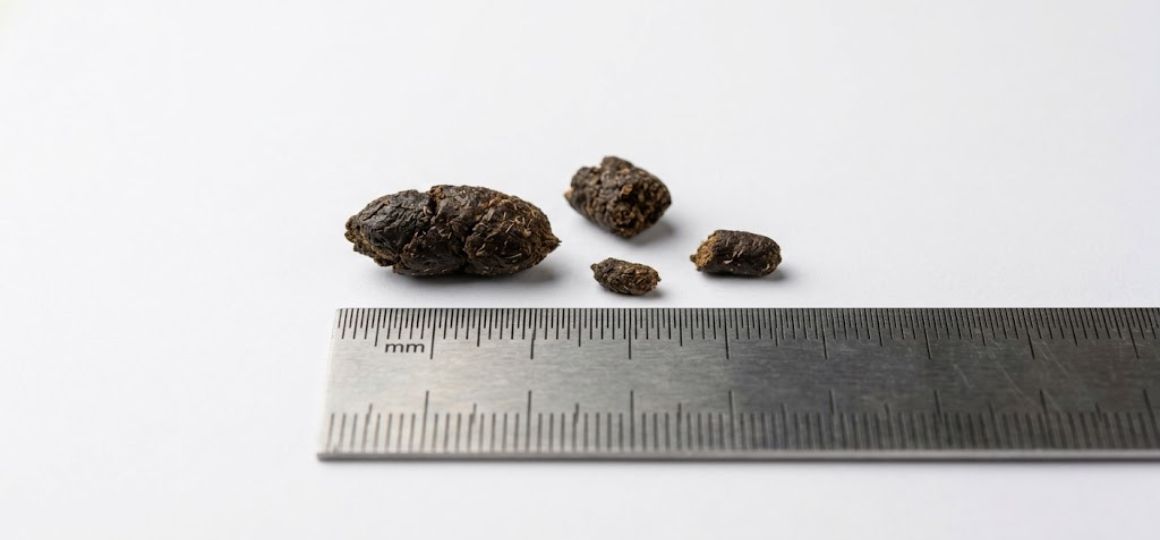
Why accurate ID from droppings matters
Droppings are the most common initial evidence Greensboro homeowners find — before they ever see a live rodent. Under a kitchen sink, inside a cabinet drawer, scattered across attic insulation, or concentrated near a crawl-space vent. What you do next depends on what you're looking at: mouse droppings indicate a gap around 1/4 inch or smaller, a program that focuses on interior trapping and kitchen-level sealing. Rat droppings — Norway or roof — indicate a larger structural entry and a program that starts with the foundation or roofline.
Getting the ID wrong before calling a pest control company often produces a mismatched program. Here's how to read what you've found.
The size rule — what the measurements actually tell you
Size is the first and most useful differentiator. House mouse droppings are 3–6mm (1/8 to 1/4 inch) — roughly the size of a grain of rice to a small sunflower seed. Roof rat droppings are 12mm (1/2 inch) — noticeably longer than mouse droppings. Norway rat droppings are 18–20mm (3/4 inch) — the size of a raisin, clearly larger than the others.
If you're unsure, put a ruler next to what you've found before touching it. The size alone narrows the species with reasonable confidence. When droppings are 3/4 inch or longer with blunt ends, Norway rat. When they're 1/2 inch with tapered ends, roof rat. When they're 1/4 inch or smaller, house mouse.
Shape and taper — the species differentiator
Beyond size, shape distinguishes rat species from each other. Norway rat droppings have blunt, rounded ends — like a small capsule. Roof rat droppings have pointed, tapered ends — they look like a tiny banana. Both are larger than mouse droppings, so if you've confirmed the size puts you in rat territory, the end shape makes the species call.
House mouse droppings have pointed ends at both tips, giving them a spindle shape — both ends come to a point. This distinguishes them from Norway rat droppings (both ends blunt) and makes them look like a small, dark rice grain.
Location of droppings — what distribution tells you about severity
A few droppings concentrated in one spot — under the sink, in a single cabinet — suggests recent entry with limited established activity. A small population or a single animal exploring a new entry. This is the scenario where a quick trap-and-seal response is typically sufficient.
Droppings distributed across multiple rooms or levels simultaneously — kitchen and pantry and behind the refrigerator — indicates an established infestation. The population has had enough time to establish multiple foraging routes through the home. Multi-room distribution is the indicator for a multi-visit treatment program rather than a spot fix.
In attic spaces, droppings scattered throughout the insulation layer — rather than concentrated at one nest site — indicate an established roof-rat colony that has been active for at least one full breeding cycle. Attic-wide distribution is the indicator for both a treatment program and an insulation assessment.
Fresh vs. old droppings — how to assess activity timeline
Fresh droppings are dark and moist with a slightly shiny surface. They harden and lighten in color as they age — typically within 48–72 hours they begin losing moisture and turning gray or dusty. Older droppings crumble when touched. Very old droppings are dull, dry, and disintegrate easily.
Finding a mix of fresh dark droppings and older gray ones indicates ongoing activity — both historical and current. Finding only old, gray, crumbling droppings may indicate a past infestation that has resolved, though it can also mean activity has moved to a different area of the structure. We use a fresh-dropping test during inspections: wipe an area clean, return after 24–48 hours, and check for new deposits. New droppings confirm active current infestation; none found suggests either resolved activity or a different zone.
What to do when you find droppings in a Greensboro home
Don't sweep or vacuum dry droppings with standard equipment. Hantavirus and other rodent-borne pathogens become aerosolized when dry droppings are disturbed. Wet the droppings with a diluted bleach solution (1:10 ratio), let sit for 5 minutes, then wipe up with disposable paper towels and dispose in a sealed bag. Wear gloves. If the accumulation is significant — attic-wide, crawl-space-wide — professional HEPA-vacuum cleanup is the appropriate standard.
After cleanup, photograph the area before wiping so you have a record of distribution and volume. Note whether droppings were fresh or old. Note the location precisely. This information speeds up the inspector's assessment significantly and helps calibrate the program scope correctly. Then call (844) 635-0403 — we'll confirm the species and recommend the right program for what you've found.
What dropping count tells you about population size in your Greensboro home
A single rodent produces a predictable amount of droppings per 24-hour period. House mice excrete 50–80 fecal pellets daily. Norway rats produce 30–50. Roof rats produce 25–45. These rates are well-documented in pest-control biology literature and don't vary significantly with diet or activity level.
The practical use: count the droppings in a defined area, divide by the daily-rate-per-animal, and you have a rough estimate of how many animals are using that area. The math isn't perfect — droppings persist for weeks before degrading, so a count includes accumulation across time — but the order of magnitude is reliable.
Example calculation. You find 200 mouse-sized droppings concentrated in a 2-foot section behind your kitchen range. If you last cleaned thoroughly behind the range four weeks ago, that's 200 droppings ÷ 28 days = 7 droppings per day in that location. At 50–80 droppings per mouse per day, that's not even one mouse's full daily output landing in that specific spot. The actual population is more — those droppings represent only the fraction landing in that one location while the mice travel through. The total population is probably 2–5 animals using that travel path.
By contrast: 200 droppings in the same 2-foot zone if you cleaned last week would indicate substantially heavier activity — perhaps 5–10 mice making routine use of that path. The same evidence has very different population implications depending on the accumulation timeline.
This is part of why we ask Greensboro homeowners during inspection when they last cleaned the affected areas. The cleaning date converts visible evidence into a deposition rate, and the deposition rate is what reveals actual current population size.
Dropping color and texture — what it reveals about timeline and diet
Beyond size and shape, dropping appearance carries additional information that helps narrow down what's happening and when:
Color tells you about diet, which can help confirm species. House mice with pantry access produce light-brown droppings (carbohydrate-rich diet). Norway rats with crawl-space access and outdoor foraging produce darker brown to black droppings (varied diet including meat scraps from outdoor scavenging). Roof rats with attic access primarily eating insulation, stored nuts, or fruit produce dark brown droppings often with visible flecks of nesting material. A homeowner finding light-brown droppings in a kitchen is almost certainly dealing with mice, not rats — color confirms the size-based identification.
Texture and moisture tell you about timeline. Fresh droppings (under 48 hours) are dark, moist on the surface, and soft when carefully pressed with a tool. They have a slight sheen. Droppings 48 hours to 2 weeks old are darker, dry on the surface, but still firm internally. Droppings older than 2–3 weeks become crumbly, lighter brown, and break apart easily. A homeowner finding both fresh and old droppings in the same location is seeing an active, ongoing infestation — not just historical activity that ended.
Distribution pattern tells you about behavior. Droppings concentrated near food sources (cabinet undersides, pantry edges, behind ranges) indicate a feeding station. Droppings along travel routes (running parallel to baseboards, edge of garage walls) indicate transit paths. Droppings clustered in specific corners or behind insulation indicate a likely nesting location nearby. The pattern across the home reveals the rodent's use of the space — where they eat, travel, and rest — which informs where to place traps for maximum effectiveness.
When dropping ID becomes hard — confusing cases and what to do
The size and shape rules work cleanly in textbook examples. In real Greensboro homes, several scenarios make identification harder than the rules suggest, and knowing the harder cases helps you respond appropriately when you encounter one.
Mixed-population droppings. Properties with both mouse and rat activity (more common than homeowners realize in older Greensboro neighborhoods) produce droppings of both sizes in overlapping locations. The reflex is to assume the bigger droppings are the "real" infestation and the smaller ones are secondary; that's not always correct. Two species can be active simultaneously, with the smaller species sometimes representing the larger or longer-established population. Photographs of a representative sample (including a ruler for scale) sent to an inspector are usually more reliable than trying to interpret mixed evidence by eye.
Degraded or partial droppings. Droppings that have been disturbed, partially cleaned, or weathered (in garage or crawl-space environments) can lose the diagnostic shape characteristics. A 1/4-inch fragment of what was originally a 3/4-inch dropping looks like a fresh mouse pellet. Looking at the freshest, most-intact specimens for ID and treating partial fragments as supporting evidence rather than primary ID source produces better results.
Non-rodent droppings that look similar. Squirrel droppings (in attics and garages) are similar in size to roof rat droppings — both around 1/2 inch, both with somewhat pointed ends. Bat droppings (rare in Greensboro, but possible in older Irving Park or Aycock homes with attic access) are smaller, drier, and crumble to powder when pressed. If the location of the droppings is consistent with a non-rodent species — particularly if you've seen squirrel activity around the home — the ID may not be a rodent at all. Professional inspection resolves these uncertain cases.
Related services
Once you've identified what species' droppings you're finding, these targeted services typically apply:
Rodent problem in Greensboro or Guilford County?
Free inspection, same-day dispatch available, written quote before any work starts. Licensed in North Carolina. Open 24/7.
Call (844) 635-0403