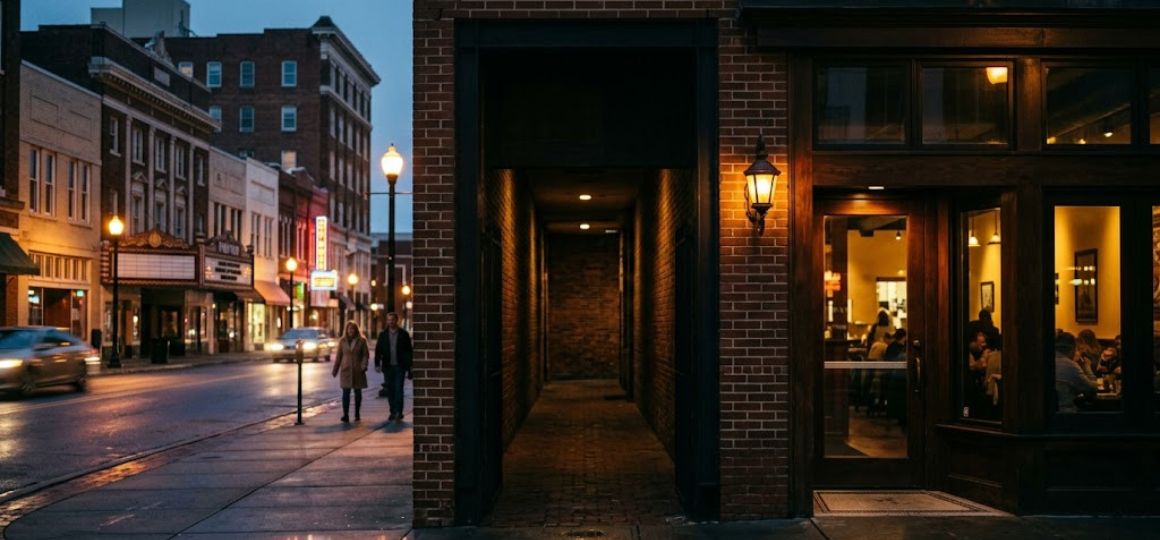
Why downtown Greensboro has a structural rat problem, not an individual sanitation problem
Downtown Greensboro restaurant operators sometimes get blamed — explicitly or implicitly — for the Norway rat activity in their blocks. The framing is wrong. Individual restaurant sanitation practices are a contributing factor, not the root cause. The root cause is structural: the Elm Street and Davie Street corridors have a configuration that would sustain Norway rat colonies at significant population levels even if every restaurant operator maintained perfect sanitation.
The three structural factors: dense restaurant clustering with shared alley waste infrastructure, early-1900s commercial building stock with sub-grade utility access that provides Norway rats with protected, climate-moderated harborage adjacent to food sources, and storm-drain infrastructure that connects the alley-resident rat population to a citywide network. The alley provides food; the building sub-structures provide shelter; the storm drains provide travel corridors and population exchange with adjacent blocks. No individual operator's dumpster management changes any of those three factors.
This matters because it sets realistic expectations. A downtown Greensboro restaurant that implements a monthly perimeter bait-station program will have a meaningfully reduced rodent problem — but probably not zero rodent pressure. The goal of a commercial rodent program in this environment is population management and documentation compliance, not eradication of all rodent activity from a shared infrastructure.
What Guilford County Environmental Health actually looks for during rodent inspections
Guilford County Environmental Health inspectors assess rodent issues in food-service establishments across several categories. Understanding what they're actually checking allows operators to focus their compliance efforts correctly.
Evidence of rodent activity: Live or dead rodents, droppings in food-preparation or food-storage areas, grease trails on baseboards indicating active travel routes, gnaw marks on food packaging or structural elements. Finding even one dropping in a food-contact area is a critical violation — the threshold for citation is low.
Pest control service documentation: An active pest control service contract and current service records are evaluated. An operator with no service records who claims to self-treat is in a weaker compliance position than an operator with monthly service logs, even if the operator with logs had a recent positive finding. The record demonstrates ongoing management effort.
Structural conditions that enable rodent access: Gaps at back-of-house door frames, missing door sweeps, foundation penetrations without rodent-grade sealing. Inspectors cite the structural conditions, not just the evidence — a clean kitchen with a 3-inch gap at the back door is a citation.
Sanitation conditions that create harborage: Standing water under equipment, accumulated grease in inaccessible areas, improperly stored dry goods. These aren't directly rodent citations but they're conditions that create harborage and sustain interior populations.
Why solo treatment programs fail in shared-alley environments
A common pattern in the downtown restaurant corridor: an operator gets a health inspection citation, hires a pest control company, gets treatment, passes re-inspection, and has a recurrence 3–4 months later. The cycle repeats annually. The frustration is real and the cause is consistent: treatment without addressing the shared-alley source population produces temporary results in this environment.
A bait-station program placed only at one restaurant's building perimeter intercepts Norway rats crossing that threshold but doesn't reduce the alley-resident colony. The colony is sustained by waste streams from multiple operators and by the sub-grade harborage that no single operator controls. Treating within a single operator's perimeter while the alley colony remains is like bailing water from a boat without plugging the hole.
The programs that produce durable results in the downtown corridor have two components that solo-perimeter programs don't: stations placed in the alley itself (or as close to it as access allows) at the dumpster enclosure and adjacent to known harborage, and coordination — even informal — with neighboring operators who share the alley. When two or three adjacent restaurants each have an active alley-positioned program, the combined coverage actually addresses the shared colony rather than just each operator's individual perimeter.
What a defensible downtown restaurant pest control program looks like
For a downtown Greensboro restaurant on the Elm Street or Davie Street corridor, the minimum program that provides both meaningful rodent management and documentation compliance has four components:
Monthly service with documented logs: Every monthly visit produces a log — stations inspected, bait consumption by station number, interior trap report, corrective actions taken. The log is formatted for Guilford County Environmental Health review. It's available within 24 hours for any unannounced inspection. This is the documentation layer that protects the operator in re-inspection and license-renewal contexts.
Alley-positioned exterior stations: Bait stations at the dumpster enclosure, adjacent to the grease-trap access area, and as close to the alley center as access allows. These address the source population rather than just the building-perimeter crossing.
Interior snap-trap program in back-of-house: Snap traps positioned in equipment kick plates, under the dishwasher, at utility-chase access areas, and along the wall-base travel routes that Norway rats use when moving through the building. Service pre-open or post-close, no disruption to operations.
Back-of-house exclusion sealing: Door sweep at the alley entry door, copper mesh at utility-line penetrations, and foundation gaps at the alley-facing foundation wall. This reduces the crossing rate from the alley into the building and gives the bait-station program less to intercept.
If you're operating a downtown Greensboro restaurant and want to establish a program that passes health inspections and actually manages the Norway rat pressure realistically — not just on paper — call (844) 635-0403. We know the downtown corridor and we'll build a program that works in the shared-alley environment rather than ignoring it.
The insurance and liability dimensions operators often miss
Beyond health inspection consequences, downtown Greensboro restaurant operators face two insurance and liability dimensions tied to rodent presence that warrant understanding:
General liability coverage exclusions. Most commercial general liability policies include clauses that exclude or limit coverage for "vermin" or "pest infestation" damage. The practical consequence: if a guest experiences harm tied to rodent presence (illness traced to contaminated food, injury from fleeing rodent, ER visit for suspected exposure), coverage isn't automatic — the carrier may dispute or deny the claim based on the exclusion language. Operators should review their specific policy language with their broker, not assume coverage exists.
Workers' compensation and OSHA reporting. Employee Hantavirus or salmonellosis cases traced to workplace rodent exposure are reportable under federal OSHA requirements and may trigger workers' compensation claims. The reporting threshold is lower than most operators assume — even a single confirmed case requires documentation, and pattern cases (multiple employees from the same facility) trigger expanded OSHA inquiry. The cost of a single workers' comp claim related to rodent exposure is usually higher than years of professional pest control service combined.
These risks aren't theoretical. We've consulted on documentation for two downtown Greensboro restaurants in the last three years where rodent-tied employee illness claims went through workers' comp evaluation. In both cases the operator's pest control documentation history was the determining factor in how the claim was handled — operators with consistent multi-year service logs fared significantly better than operators with inconsistent or recently-started programs.
The cost framework — what defensible programs actually cost downtown operators
For Elm Street and downtown Greensboro restaurant operators planning realistic budgets, here's the cost structure of a defensible (rather than minimal) pest control program:
Standalone independent restaurant on Elm Street, alley access shared with 2–4 neighboring businesses, 1,200–2,400 sq ft of kitchen and back-of-house space. Initial setup with comprehensive baseline documentation: $1,200–$2,000 one-time. Monthly monitoring with rotating bait station service, log update, and standing on-call availability: $325–$525/month. Annual reset and audit-prep documentation review: $400–$700 once yearly. Total first-year cost: approximately $5,700–$8,800. Total ongoing annual cost after year one: approximately $4,300–$7,000.
Multi-location operator or larger downtown footprint (multiple bars and restaurants under common ownership, shared back-of-house). Costs scale with monitoring point count, not linearly with revenue. A four-location operator might run $1,200–$1,800/month total under a combined-portfolio rate, with shared documentation infrastructure across the locations. The per-location cost is meaningfully lower than four separate single-location programs.
What "cheap" programs deliver — and why they fail. Quotes in the $125–$200/month range for downtown Greensboro restaurant pest control exist. What they typically include: minimal bait station inventory, quarterly rather than monthly service intervals, generic documentation rather than facility-specific records, and no proactive engagement with the shared-alley dynamic. These programs technically check the "we have pest control" box, but they don't withstand health-inspection scrutiny when problems develop and they don't provide the documentation trail that helps in liability situations. Operators on these programs frequently end up needing remedial work that costs more than years of properly-priced service would have.
The honest framework: defensible pest control for downtown restaurants is not a discretionary expense to minimize. It's operational infrastructure with measurable risk-reduction value. Operators who frame it that way and budget accordingly avoid the structural problems that catch operators trying to run rodent control as a low-priority line item.
Related services
For downtown Greensboro restaurant operators, these are the service categories that build a defensible program:
Rodent problem in Greensboro or Guilford County?
Free inspection, same-day dispatch available, written quote before any work starts. Licensed in North Carolina. Open 24/7.
Call (844) 635-0403