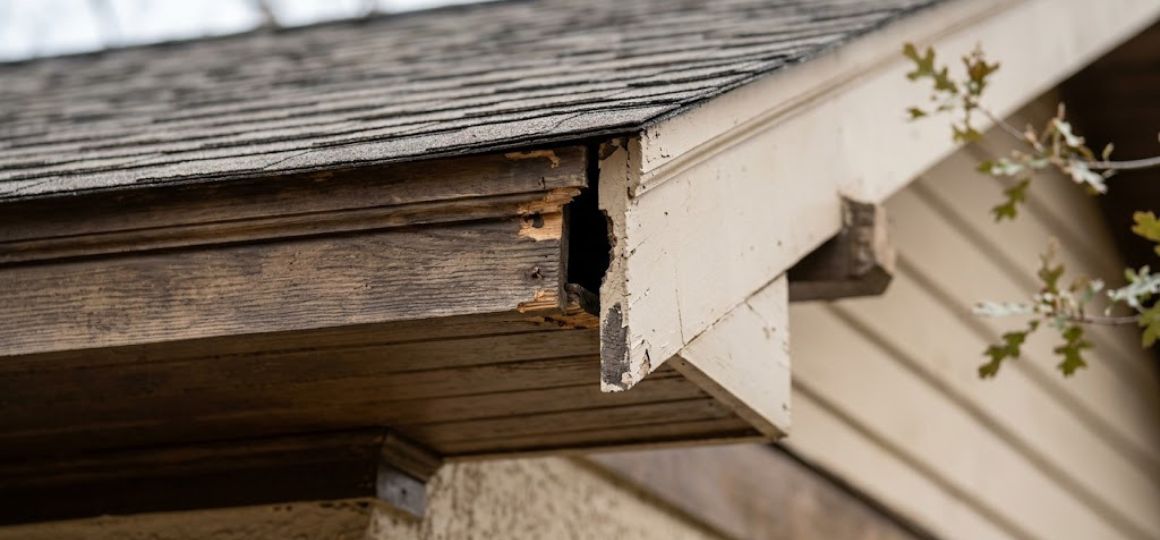
Why older Greensboro homes are at disproportionate risk
Roof rats need two things to infest a home: canopy access to the roofline and a structural gap large enough to enter. In Greensboro, the neighborhoods with the highest roof-rat call density are not the newest or most poorly maintained — they're the ones with the most mature hardwood canopy and the oldest housing stock. Irving Park, Old Irving Park, Fisher Park, Latham Park, and Sunset Hills have both conditions: decades-old oak trees with limbs that contact rooflines, and homes built before 1970 with original soffit and vent systems now showing their age.
A craftsman bungalow built in 1925 in Irving Park was constructed with wood-frame gable vents and an original soffit system. That soffit system has experienced 100 winters of expansion and contraction. The wood has moved, the paint has cycled, and the junction between the soffit and the fascia board has widened — in some places by 1/4 inch or less, in others by enough to slide a finger through. That gap plus the limb that the white oak dropped onto the roofline last summer equals a roof-rat entry.
Gable vents — the most common entry in pre-1970 homes
The gable vent is the triangular or rectangular louvered opening at each end of the attic, positioned at the peak of the gable wall. In homes built before 1970, these vents typically have a wood frame with a metal or aluminum screen behind the louvers. That screen is now 50–100 years old.
Deterioration happens from the outside in — UV exposure, moisture from rain hitting the louvered face, and thermal cycling all degrade the screen. By the time a homeowner can see that a screen is missing, roof rats have been using that entry for at least one season. The failure isn't always visible from the ground; it often requires getting up to the gable face to inspect the screen condition.
The fix: remove the existing screen and install a 1/4-inch hardware-cloth frame on the interior face of the gable vent opening — between the vent louvers and the attic interior. Interior-mounted rather than exterior-mounted preserves the original vent appearance from outside while providing rodent-grade exclusion at the actual entry point. For heritage homes in Irving Park and Fisher Park where the gable-vent design is architecturally significant, stainless-steel mesh in a custom-fitted frame is the appropriate material.
Soffit-return gaps — the entry point that gets worse every decade
The soffit return is the horizontal surface under the roof overhang at the eave — it connects the bottom edge of the roof to the top of the exterior wall. Where the soffit panel meets the fascia board (the vertical board behind the gutter), there is a wood-to-wood junction that widens as both pieces of wood move independently over decades. In many older Greensboro homes, this junction has opened to 1/4 inch or more along significant portions of the eave run.
Roof rats, once they've reached the roofline via a tree limb, explore the perimeter of the eave looking for gaps. The soffit-return junction is one of the most productive. A rat can squeeze through a 3/4-inch gap, and many soffit-return separations in Greensboro's older homes are at or past that threshold.
The fix: custom-bent galvanized or aluminum flashing sized to the specific gap width and installed to close the junction without blocking the soffit vent perforations that provide attic ventilation. The flashing closes the wood-separation gap; the soffit perforations remain open. For homes where the flashing would be visible, pre-painted aluminum matching the soffit color is the aesthetic approach.
Roofline penetrations — plumbing stacks, HVAC lines, chimney gaps
Every plumbing vent stack exits through the roof plane with a flashing collar. Over time, gaps develop at the collar edge — between the flashing and the pipe, or between the flashing and the roof surface. A gap of 3/4 inch at a plumbing stack is a roof-rat entry point as viable as any gable vent. These gaps are often overlooked because they're not in the obvious "vent" category — they look like normal roofline hardware.
HVAC condensate and refrigerant lines typically exit through exterior walls near the roofline. The penetration was sealed at installation — often with foam. That foam has degraded. The gap around the lines is now open. Roof rats that reach the wall face at roofline height will find and exploit these gaps.
Chimney chases in older Greensboro brick homes create a gap where the chimney structure meets the roof framing — a wood-to-masonry junction that opens as settling occurs. This is a less common but entirely viable roof-rat entry in homes with brick chimneys, particularly where the chimney chase has a wood-frame surround.
The canopy factor — why tree trimming is part of the solution
Exclusion sealing without canopy management is a partial solution in Greensboro's most affected neighborhoods. Roof rats reach the roofline via tree limbs — that's the delivery mechanism. Seal every current entry point with perfect hardware cloth and stainless-steel mesh, and the roof rats will pressure the sealed perimeter from the same limb contact points. They'll probe sealed areas repeatedly. Eventually, if a seal has a weak point, they'll find it.
Removing limb-to-roofline contact — specifically any limb that touches or overhangs the roof, gutter, or soffit — breaks the delivery mechanism. Roof rats can jump a few feet but they can't fly; 6 feet of clearance between any tree limb and any part of the roofline or structure is the standard recommendation. We document which specific limbs create contact during roofline inspections and provide that documentation for an arborist. Trimming doesn't replace exclusion sealing; it makes exclusion sealing more durable.
Material standards for roofline exclusion sealing
The mesh standard for roofline exclusion is the same as for crawl-space exclusion: 1/4-inch welded wire mesh, 19-gauge, galvanized or stainless. The difference is that roofline locations often involve aesthetic considerations that crawl-space work doesn't. Galvanized hardware cloth oxidizes and develops a rust patina over time — acceptable on a foundation vent hidden behind shrubbery, less acceptable on a visible gable vent on a 1925 craftsman in Irving Park.
Stainless-steel mesh in the same 1/4-inch specification oxidizes more slowly and maintains a cleaner appearance over time. For heritage homes in Greensboro's historic districts — Irving Park Historic District, Fisher Park Historic District — stainless mesh in custom-fitted frames that match the original vent profile is the appropriate material choice. It costs more; it's also the material that doesn't create a maintenance cycle where you're replacing corroded hardware cloth every 5–7 years on a historic home. Call (844) 635-0403 for a roofline assessment and we'll walk through the specific entry points on your home.
The eight most common roof rat entry points in older Greensboro homes — ranked by frequency
Across years of roof rat work in Greensboro's older neighborhoods, the entry-point distribution follows a consistent pattern. Knowing the order helps homeowners and inspectors focus attention on the highest-probability locations first:
1. Gable vent screen failures (38% of cases). The most common single entry point. Original wood-framed gable vents from 1920s–1960s construction used 1/2-inch screen mesh that has corroded, torn, or pulled loose from the frame over decades. The screen gap creates direct attic access. Visible from ground level on most homes by looking at gable-end vents through binoculars; the rusted or torn pattern is usually clear.
2. Soffit-return separation (24% of cases). The location where the soffit meets the fascia at the roof corner. Decades of seasonal expansion/contraction, water infiltration, and wood degradation create separation gaps that admit rats traveling along the roofline. Often impossible to see from ground level — requires ladder access or roofline inspection.
3. Roofline penetrations around plumbing stacks (12% of cases). The boot collar around bathroom vent stacks that exit through the roof — neoprene material degrades over 15–25 years and cracks at the collar edge. The resulting gap admits rats traveling the roof surface. Visible from the roof but not from ground level.
4. Damaged or missing ridge vent (9% of cases). Continuous ridge vents that have lost end caps, developed open seams, or been damaged by tree-limb impact create attic access from the roof peak. Less common in pre-1970 construction (ridge vents weren't standard until later) but present in some renovated older homes.
5. Chimney flashing gaps (7% of cases). The metal flashing that seals chimney bases to the roofline can develop gaps as flashing ages, mortar fails, or chimney settles. Rats traveling the roof surface or climbing the chimney use these gaps for attic access.
6. HVAC line penetrations (5% of cases). Where mini-split refrigerant lines or modern HVAC penetrations exit through exterior walls high on the structure. Originally foam-sealed at install; degraded over time. More common in homes that have had HVAC upgrades than in untouched original homes.
7. Dryer vent terminations (3% of cases). When dryer vent caps fail or are missing entirely. Less common than other roofline entry points because dryer vents are usually below the canopy zone roof rats prefer, but possible in homes where the vent terminates at gable-end height.
8. Other unique architectural elements (2% of cases). Decorative dormer trim, cupolas, original wood architectural details — varies by home. These are rare individually but worth checking on architecturally complex older homes where standard inspection coverage may miss specific elements.
What fails first — predicting which entry points will develop based on home age and exposure
For Greensboro homeowners in older homes wanting to know which roof rat vulnerabilities to address proactively, the failure-order pattern based on exposure is reasonably predictable:
Years 0–15 post-construction or post-renovation: typically no roof rat vulnerabilities. New construction materials in good condition; no entry points yet developed.
Years 15–25: first failures appear, almost always in gable vent screens (especially original wood-framed vents) and plumbing-stack collar boots. Both reflect material degradation rather than structural settling.
Years 25–40: second wave includes soffit-return separations and flashing gaps. Structural movement and wood degradation drive both. This is the age where comprehensive roofline inspection becomes valuable — many points are starting to fail simultaneously.
Years 40+: all roofline entry-point types are candidates. For Greensboro homes in Irving Park, Fisher Park, Aycock, Westerwood, and Sunset Hills (most of which are 50–100 years old), inspection should assume any entry point can be present. The original construction integrity is no longer protecting against rodent ingress.
The implication for proactive maintenance: a one-time professional roofline assessment around year 20 of a home's age (or year 20 after a major renovation) is well-timed to catch first-generation failures before they become entry points. Greensboro homes in the 1990s–2000s construction wave are reaching this assessment-worthy age now.
Related services
For older Greensboro home owners addressing roof rat issues, the directly applicable services are:
Rodent problem in Greensboro or Guilford County?
Free inspection, same-day dispatch available, written quote before any work starts. Licensed in North Carolina. Open 24/7.
Call (844) 635-0403